






Ancient Beers Get Second Life in Collaboration with Ashland Brewery

Budweiser crowns itself “the king of beers.” But an ale fit for Vikings? That laurel goes to Gotlandsdricka.
Originating on Sweden’s largest island, Gotlandsdricka (literally “drink of Gotland”) served as an everyday drink for the Vikings as far back as 800 C.E. While you probably won’t find a six-pack of Gotlandsdricka at your local supermarket, the style lives on in homebrewing circles and craft breweries like Ashland’s own Center of the Universe (COTU), which partnered with of-age students in History Professor Dr. Michael Fischbach’s “Brewing and History” course this semester to bring five ancient ales to life.
“Farmhouse ales like Gotlandsdricka are the O.G. craft beer movement,” COTU brewer Nathan Landers ’16 said during the first event in COTU’s Historic Beer Series. “Today’s craft scene is all about brewing local beer for local people. Farmhouse ales—brewed on farms using their own grain for their own workers—vary by location depending on the ingredients available to and the techniques passed down within each community.”
Landers, a graduate of RMC’s History program, has previously collaborated with the College since he joined COTU in 2016. While Landers tinkers with the beer-making process, students in Dr. Fischbach’s class place the drinks in their proper historical context, writing about each style’s evolution and significance and sharing their research with the Ashland community.
“The history of beer is also the history of mankind,” Landers said. “Every beer tells a story about history, culture, landscape, and ultimately ourselves.”
Raiders, Traders, and Imbibers
Kyle Alberici ’22 (History major, Cybersecurity and Political Science double-minor) adopted Gotlandsdricka as the focus of his research given its provocative backstory. “What’s more exciting than beer and Vikings?” he joked during the beer’s official rollout at COTU on October 28.
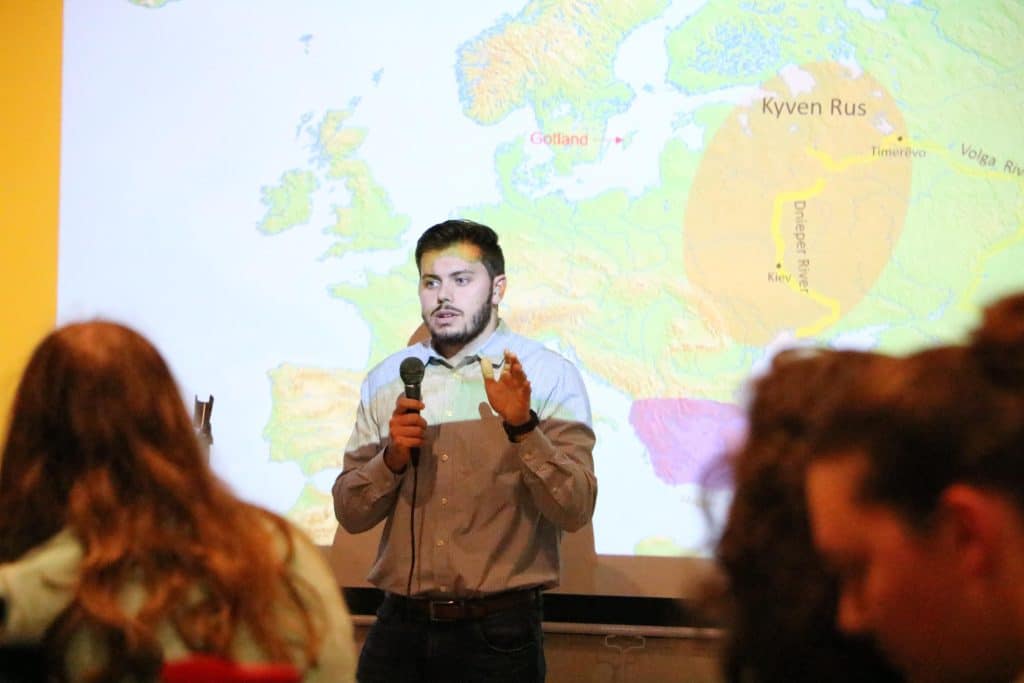
Alberici noted that although their reputation as helmet-wearing pillagers is made plain in the archaeological record, Vikings were adept merchants, too. They formed vast trade networks stretching from the Middle East to Iceland, a fact made evident in the Italian glass, Russian religious artifacts, and Arabian coins unearthed on Gotland. The island played a central role in the Vikings’ trade routes since it allowed easy access to virtually all of Northern Europe. Vikings would travel east from Gotland toward modern-day Russia and trade goods with the Byzantine Empire and the Abbasid Caliphate, afterwards returning to Gotland to stash their riches. Gotland thus became one of the wealthiest trading centers in the Viking world.
“Gotland formed a unique society, both commerce-driven and egalitarian, in which status was built not on which family you were born into, but on the wealth you amassed,” Alberici said. “The hoards of treasure found on the island demonstrate that Gotland was a central space in the Viking imagination. The abundance of buried riches may have served as a message to passersthrough that Vikings controlled the trade networks in that part of the world.”
Old Beer in a New Light
Despite Gotland’s reliance on trade, farms dotting the island cultivated regional grains that were used to make its namesake beer. Those grains, whether in the form of wheat, barley, or rye, were always smoked, giving Gotlandsdricka a characteristic flavor. Other defining features of the farmhouse ale include the liberal use of juniper—a natural sanitizer, preserving agent, and flavor enhancer—as well as reliance on an ancient strand of Norwegian yeast called kveik. The resulting beer is woody, floral, funky, and sweet, with hints of tropical citrus.
COTU’s iteration features less smoke (“to fit the modern palate,” Landers explained) with the addition of hops necessary to qualify the drink as beer instead of malt liquor. Otherwise, Landers said, “This brew stays pretty close to its roots.”

Landers, who has been homebrewing his own beer since he was 21, used six pounds of juniper branches cut from his own backyard for COTU’s first batch of Gotlandsdricka. He thought about smoking the grains in-house, but admitted outsourcing that task since “being the father of a newborn doesn’t leave you a lot of time for such a level of precision.”
Nevertheless, he says he enjoys reverse-engineering centuries-old recipes using modern brewing techniques, and plans to continue the Historic Beer Series in years to come. Over the past three years (skipping last year due to the pandemic), COTU has worked with Randolph-Macon students to breathe new life into a variety of historic beers styles up through 1000 C.E. Next on tap in COTU’s Historic Beer Series include:
- A Kottbusser to be released on November 18, 2021 (researched by Michael Hill ’22)
- A Gruit to be released on December 9, 2021 (researched by Shannon Benton ’22)
- A Welsh Braggot to be released on January 13, 2022 (researched by David Lewis ’22)
- A Patagonian Chicha to be released on January 27, 2022 (researched by Ana Leal ’22)
“This series is a great way to initiate a conversation with each other about where we come from,” Landers said. “Plus, all conversations are more fun when they’re initiated by beer.”


