


Ahead of the Game: Discussions About Art and Architecture in Ancient Sports
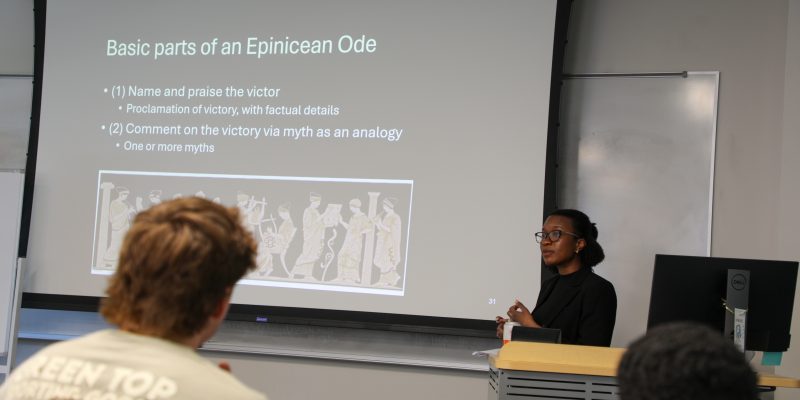
Students in Dr. Nadhira Hill ’16’s The Art and Architecture of Ancient Athletic Games course watched the 2026 Winter Olympics but not in the way one might think. Beyond viewing the games for the enjoyment of the sport, students analyzed them from a historical perspective. The Olympics have evolved in many ways to reach their modern form, with new sports and a separate Winter Olympic program, but the origin for what we see today comes from Ancient Greece.
“I asked them to try to determine what pieces of it were ancient,” Hill explained, detailing conversations in the course, which meets the Aesthetic Expression pillar requirement in Randolph-Macon’s curriculum. “We looked at speed skating, and that was really interesting, seeing what students picked up on and what they thought were totally different.”
Applying what they were learning to what was currently happening made the course especially relevant, but the experiences taking place in the course were not limited to studying the Olympics. At the beginning of each class, students study an image, object, text, or form of architecture, building on prior lessons. Modern athletics are heavily influenced by Ancient Greece and Rome, so students analyzed structures like the Coliseum, whose features we see reflected in today’s football stadiums and running tracks.

One object that was recently studied in class was a panathenaic vase, which is associated with the civic games in Athens. The civic games were a Greek athletic festival that consisted of different competitions where vases were often rewarded as prizes. “Even if you find a little piece of the vase, you’ll know exactly where it’s from and what it was used for,” Hill said. Each panathenaic vase has a distinct egg-shaped body with a narrow neck. It includes an image of Athena, the patron goddess of Athens, and often has the name of the magistrate of Athens that year, as well as a picture of the athletic event.
Lexie Griffith ‘28, an Archaeology and Classics double-major with an Asian Studies minor, reflected on how the course has reinforced the skills she uses in her other major courses. “We only know about [the artifacts we see today] because of the past scientists and researchers who have interpreted them,” Griffith said.
A significant part of the class is drawing conclusions from the physical remains of spaces like stadiums, theaters, and sanctuaries. “I’m teaching the students how to recognize what they’re seeing and interpret what they’re seeing for the context of those games but also for cultural values,” Hill said.
One activity that uses those critical thinking skills is the extra credit “training games,” where students answer practice questions, a fun, competitive way to review for upcoming tests while bonding with other students in the class.
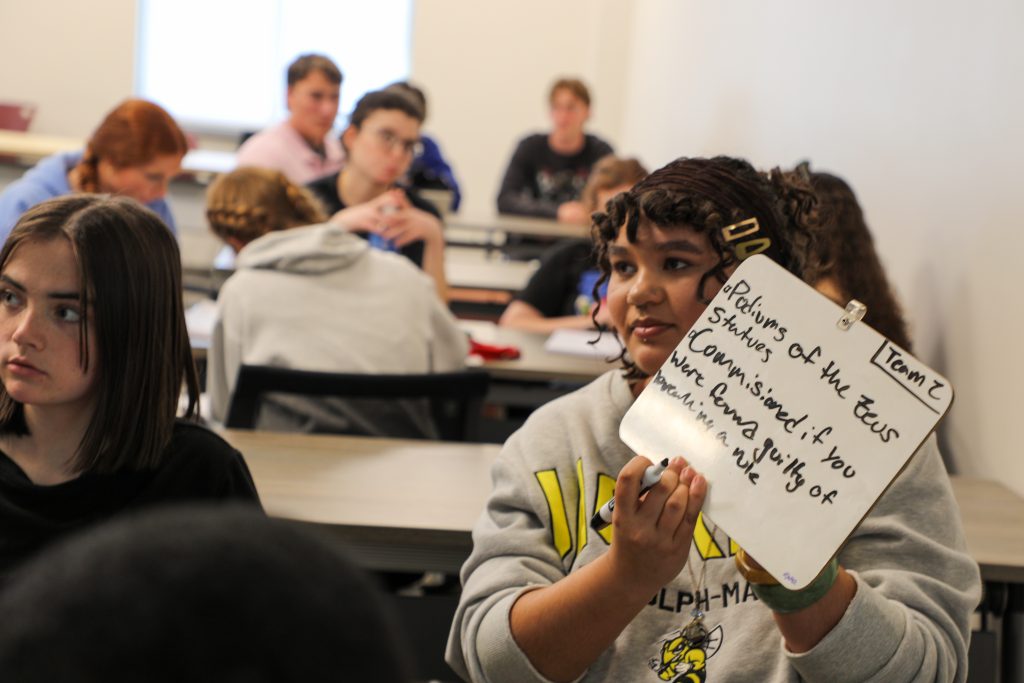
In The Art and Architecture of Athletic Games, students also discuss elements of sporting events based on an analysis of ancient texts. One discussion centered on athletes who broke the rules and the penalties they faced as a result of their disobedience. In contrast, some events had very few rules, like a combat sport called pankration that omitted rules entirely except for not biting your opponent or gouging out their eyes.
Kari Nordvig ‘27, a Music and Arts Management double-major with an Archaeology minor, explained the basics of the rules in ancient athletic games. “All of the rules were centered around fair play. You were not allowed to bribe; you were not allowed to cheat; you were not allowed to false start.” She then clarified that fairness does not mean safety. In fact, she said that the games were quite the opposite of safe. They were often more violent and could lead to injuries or death, especially in sports such as boxing, wrestling, or pankration.
Although some of the ancient rules are still in place today, many students observed that the rules were more lenient back then. However, the penalties for breaking them were more severe. Punishments could include whipping, paying a fine, or even having to set up a statue of the god in whose honor the games were held.
“[Dr. Hill’s] classes have opened up my world so much … a lot of it is realizing and recognizing that I can see the world through many different perspectives and different angles,” Nordvig said. “In the future, yes, I’ll know the facts, but I think it’s more that I realize that there’s a way to make my world larger and to get different perspectives.”